Worsley Urban
The Roncy on Roncesvalles: What Changes When the Developer Also Manages Construction
Last updated: November 6, 2026
Acting as the developer and construction manager for a Toronto condo is the role Worsley Urban held at The Roncy, an 8-storey mixed-use building with 93 residential units and retail at grade at 422 to 436 Roncesvalles Avenue, plus townhomes on Howard Park Avenue. The site was a constrained main-street parcel in an established low-rise neighbourhood, the former site of a funeral home. The question this case answers is a practical one: what changes for schedule, budget, accountability and risk when the team that set the strategy and carried the approvals also runs the build, instead of handing the construction to a separate party?
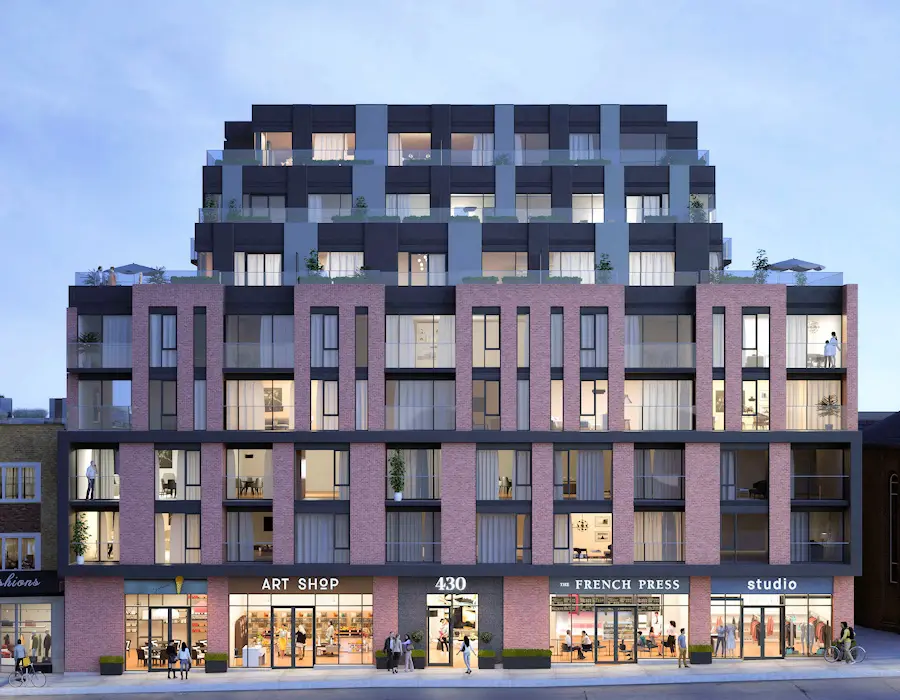
- The Roncy at 422 to 436 Roncesvalles Avenue is an 8-storey mixed-use building with 93 residential units, retail at grade and townhomes on Howard Park Avenue.
- Worsley Urban acted as developer and construction manager on The Roncy, carrying the approvals and the build under one roof.
- The Roncy's rezoning was appealed to the Ontario Municipal Board in 2016 and settled; the site plan file is City application 17 174229 STE 14 SA.
- A single developer-construction manager keeps design intent, approval conditions and site decisions with one accountable party from planning through completion.
- A separate stipulated-price general contractor can transfer more price risk off the owner, but it also moves decisions away from the party that negotiated the approvals.
- Ontario's Construction Act governs holdbacks and prompt payment on every project, whichever delivery model an owner chooses, and its rules should be confirmed for each site.
Why a Developer and Construction Manager for a Toronto Condo Changes the Risk Picture
A developer who also acts as construction manager keeps one party responsible for the decisions that usually get split between two organisations. On most mid-rise condominium projects, the developer secures the land, sets the strategy and wins the approvals, then signs a contract with a general contractor who builds. That split is common and it works. It also creates a seam.
The seam sits between the people who know why the building looks the way it does and the people who have to build it. Approval conditions, setbacks, the shape of a rear transition toward houses, commitments made to a neighbourhood: all of it has to be translated from one team to the next. Every translation is a chance for cost, time or intent to slip.
If you are a landowner with a narrow main-street lot backing onto a residential street, weighing whether to sell, partner or develop, this question matters to you directly. So does it for a construction lender underwriting completion risk, or an institution looking for a local partner who can execute without a hand-off in the middle. At The Roncy, Worsley Urban removed the seam by carrying the approvals and the build under one roof.
What We Found
The Roncy site carried the classic constraints of an infill parcel on a Roncesvalles Village main street. The approval path was contested: the rezoning was appealed to the Ontario Municipal Board in 2016 and settled. That one fact shapes everything after it, because a settled approval comes with specific commitments that the finished building has to honour.
Two frontages raise the stakes further. A mid-rise mixed-use building on Roncesvalles Avenue and townhomes on Howard Park Avenue are two different building types, facing two different street conditions, on one site. Main-street retail at grade needs storefront depth and servicing that work with a busy commercial strip, while townhomes need to sit comfortably beside existing houses. Construction on a site like this generally has to manage staging, deliveries and crane or hoist access with very little open land around the footprint.
The diagnosis, in plain terms: on a tight site with a negotiated approval, the risk is not only in pouring concrete. It is in the gap between what was agreed and what gets built. That gap is easiest to close when one team owns both sides of it.
How We Solved It
Developer-led construction management is the delivery model Worsley Urban used at The Roncy: one team carried the approvals and the build. The steps below describe how that structure works in general on a mid-rise condominium, and the industry-standard tools and contract forms commonly used to run it. They explain the model; they are not a diary of the site.
- Carry the approval record into the build. Under one roof, the conditions of a settled approval and the site plan file (here, City application 17 174229 STE 14 SA) stay with the team that negotiated them, rather than being summarised for an outside contractor.
- Contract trades directly under a construction management structure. In Canada, the Canadian Construction Documents Committee publishes standard forms such as CCDC 5A (construction management for services) and CCDC 5B (construction management for services and construction). In a CM structure the owner holds trade contracts, so budget lines stay visible line by line rather than inside one lump sum.
- Schedule against site constraints, not just durations. Scheduling software such as Oracle Primavera P6 or Microsoft Project lets a construction manager sequence a tight site around deliveries, hoisting and sidewalk access on a busy commercial street.
- Run drawings and changes on one record. Platforms like Procore for project records and Bluebeam Revu for drawing markup keep requests for information, change orders and approved revisions in one place, which matters when a change could touch an approval condition.
- Manage holdbacks and payments under the Construction Act. Ontario's Construction Act sets holdback and prompt payment rules for every project. A developer who is also construction manager administers those obligations directly, and the current rules should always be confirmed with counsel.
- Carry the project through completion. The same team that set the strategy closes it out, so the finished building, retail at grade and townhomes on Howard Park Avenue, can be measured against the original intent by the party accountable for it.
The developer evaluates the land and decides what the site can carry.
The same team leads planning and settles the terms the building must meet.
No hand-off: the team that negotiated the approval manages the trades and the schedule.
One accountable party delivers the finished building.
One Team or Two: Delivery Models Side by Side
Choosing between a developer-construction manager and a separate general contractor is a trade-off, not a verdict. Each model wins in specific conditions. The table sets out how they generally differ on a mid-rise condominium.
| Factor | Developer as construction manager | Separate stipulated-price contractor |
|---|---|---|
| Schedule | Construction planning can overlap with late approvals and design, since one team holds both. | Pricing usually waits for more complete drawings, which can push the start later. |
| Budget | Trade costs stay visible line by line; the owner carries more cost variance. | A lump sum (often on a CCDC 2 form) shifts more price risk to the contractor, usually with a premium built in. |
| Accountability | One party answers for approvals, design intent and the build. | Responsibility is split; disputes over scope and changes are more likely at the seam. |
| Approval conditions | Negotiated commitments stay with the team that agreed to them. | Commitments must be translated into contract documents and policed. |
| Where it wins | Constrained infill sites with negotiated approvals and a sponsor with construction depth. | Simpler sites, complete drawings, or an owner without in-house construction capability. |
The honest reading: a fixed-price contract buys price certainty, and that is valuable. It does not buy the knowledge of why each approval condition exists. On a site like 422 to 436 Roncesvalles Avenue, that knowledge carries real weight.
What This Means for Landowners, Lenders and Institutions
For landowners, The Roncy shows that a constrained main-street parcel in an established low-rise neighbourhood can carry an 8-storey mixed-use building with 93 residential units when the strategy fits the context. The lesson is about who stays at the table. A landowner who partners with a developer that also builds keeps one counterparty from approval to completion, instead of watching the project change hands halfway. Whether that structure suits a given property is a question for the owner's own legal, tax and financial advisers.
For lenders, the developer and construction manager for a condo is the party managing the budget, the schedule and completion risk directly. That changes what to underwrite. A lender in this model looks hard at the sponsor's construction capability, cost reporting and contingency discipline, because no outside lump-sum contractor is absorbing overruns. Worsley Urban's principal, Dino Longo, is a third-generation developer with more than four decades of experience across ownership, investment, development and construction, which is the kind of depth this model depends on.
For institutional investors, a local execution partner who carries approvals and the build under one roof reduces the number of organisations whose interests have to be aligned. The Longo family entered real estate in 1921, and Worsley Urban and the Longo Group have delivered commercial and industrial development across Mississauga, Markham and Vaughan as well as the city. On a site where negotiated commitments shape the building, fewer hand-offs means fewer places for intent to be lost. Rules and markets change, so any partner structure should be reviewed against current conditions.
Our view
This is opinion. Readers comparing delivery models tend to overweigh the headline contract price and underweigh the cost of the seam between planning and construction. A lump sum looks certain on paper. Change orders, scope disputes and reinterpreted approval conditions are where that certainty often erodes.
What matters more is whether the sponsor can genuinely build. Developer-led construction management only reduces risk when the developer has real construction depth; without it, the model simply moves risk onto an owner who cannot manage it. That is why sponsor capability, not contract form, deserves the first question.
Neither model is right for every site. A clean suburban parcel with complete drawings may suit a stipulated-price contractor well. A tight main-street site with a settled approval, like The Roncy, is where one team holding both roles earns its keep.
FAQ
What does a developer acting as construction manager actually take on?
A developer acting as construction manager takes on the build as well as the strategy and approvals: trade contracting, scheduling, cost reporting and completion. At The Roncy, Worsley Urban held both roles for an 8-storey, 93-unit mixed-use building. Standard CCDC 5A and 5B forms are commonly used to structure construction management in Canada.
Does one team holding approvals and construction lower the price of a project?
One team holding approvals and construction does not guarantee a lower price; it changes who carries cost variance and how visible costs are. In a construction management structure the owner sees trade costs line by line, while a stipulated-price contract (often CCDC 2) moves more price risk to the contractor. For pricing on a specific project, contact Worsley Urban directly.
How should a lender assess a developer-construction manager sponsor?
A lender assessing a developer-construction manager sponsor should focus on construction capability, cost reporting, contingency and completed projects. Worsley Urban's work includes The Roncy on Roncesvalles Avenue, and its principal has more than four decades of experience across development and construction. Each lender should apply its own underwriting and advice.
Can a constrained main-street lot beside houses support a mid-rise building?
A constrained main-street lot beside houses can support a mid-rise building in some cases: The Roncy, an 8-storey building with townhomes on Howard Park Avenue, is one example. Its rezoning went to the Ontario Municipal Board in 2016 and settled. Planning rules change, so any site must be confirmed against current policy with the municipality and professional advisers.
Sources
- Background on 422 to 436 Roncesvalles Avenue and its 2016 appeal - Municipal staff report, November 10, 2016
- Successor tribunal to the Ontario Municipal Board - Ontario Land Tribunal
- Holdback and prompt payment rules - Ontario Construction Act, R.S.O. 1990, c. C.30
- Standard construction management contract forms (CCDC 5A, 5B, CCDC 2) - Canadian Construction Documents Committee
Every opportunity begins with a conversation. If you are a lender or institution looking for an experienced sponsor or a local execution partner who carries approvals and construction under one roof, reach Worsley Urban privately at worsley.ca/#contact or dlongo@longocorp.com. Completed work, including The Roncy, is shown at worsley.ca/#projects.
Worsley Urban
Worsley Urban (worsley.ca) is a Toronto real estate investment and development firm at 3657 Lake Shore Boulevard West, Toronto.
Discuss a Sponsor Who Builds What It Gets Approved