Worsley Urban
What Do Construction Lenders Look For in a Development Sponsor in Canada Right Now?
Last updated: November 27, 2026
What do construction lenders look for in a developer in Canada as of late 2026? They look for a sponsor who has finished comparable projects, can hold a budget and schedule, puts real equity at risk, carries enough contingency, and can absorb a cost overrun without stalling the job. OSFI's Capital Adequacy Requirements 2027, Chapter 4, now ties how much capital a bank must hold against a construction loan to pre-sales and equity at risk, so those sponsor qualities show up directly in the bank's own cost of lending.
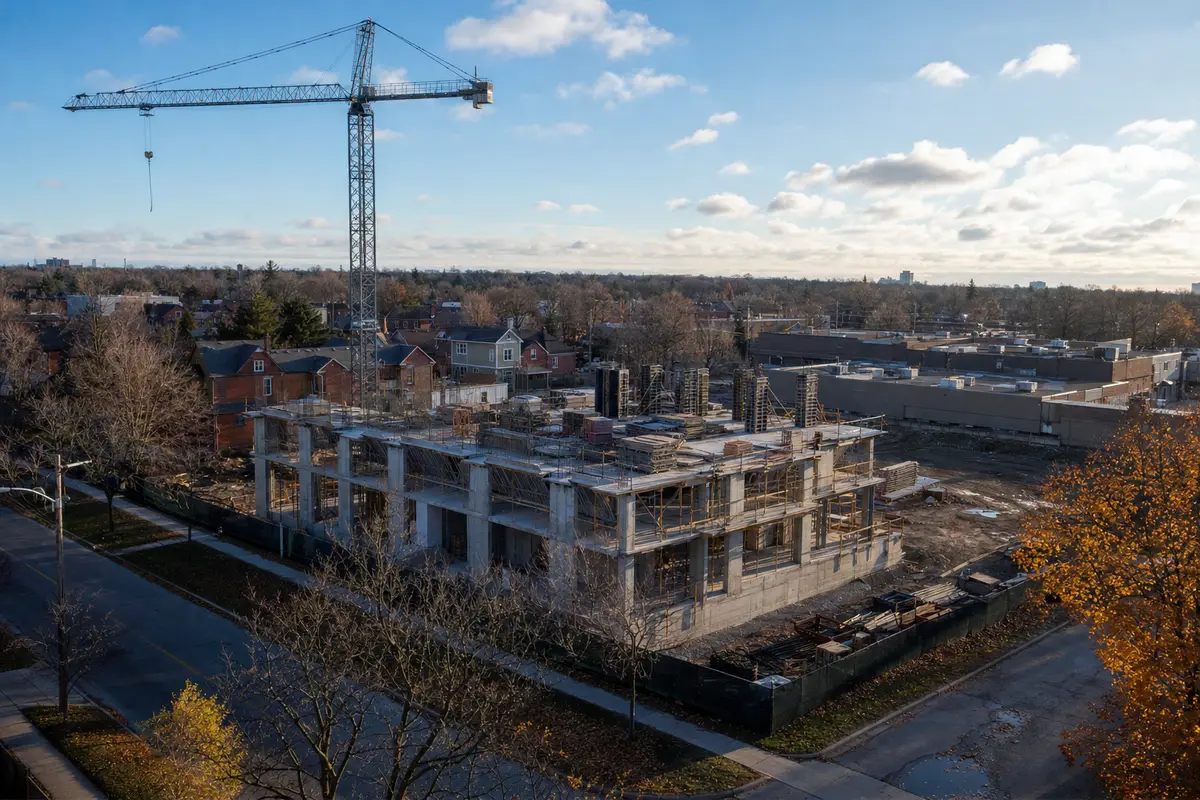
- Under OSFI CAR 2027, Chapter 4, high-rise residential construction is defined as 7 or more storeys, and the bank's risk weight falls from 150% to 100% to 90% as pre-sales rise past 50% and 75%.
- Under the same OSFI chapter, low-rise and purpose-built rental construction can receive a 100% risk weight regardless of pre-sales if equity at risk is at least 25% of appraised as-completed value, with at least 5% of it in cash.
- CMHC's Apartment Construction Loan Program highlight sheet asks borrowers for 5 years of property management experience (or a third-party manager with 5 years), a completed similar project or a fixed price contract, and the ability to withstand unexpected cost increases.
- An 8-storey building like The Roncy on Roncesvalles Avenue or Eight Forty on St. Clair Avenue West would fall on the high-rise side of OSFI's new 7-storey line.
- Lenders read completion risk through the sponsor: track record, construction management capability, contingency and liquidity matter as much as the land.
The Short Answer: What Construction Lenders Look For in a Developer
Construction lenders look for a developer in Canada who lowers completion risk. That means a record of finishing similar buildings, a budget built from real pricing, a realistic schedule, a contingency that can take a hit, equity that stays in the deal, and the liquidity to fund an overrun without going back to the lender.
What changed is that the rules now make this measurable for federally regulated banks. OSFI's Chapter 4 links capital charges to pre-sales and equity at risk, and CMHC's apartment program spells out experience and cost-resilience tests. A sponsor who meets those tests is cheaper and easier to lend to. The rest of this answer explains each test from the lender's side of the table.
The Full Answer
How construction lenders evaluate a development sponsor comes down to one question: if something goes wrong between excavation and occupancy, who finishes the building? If you are a lender reviewing a GTA mid-rise file, or a landowner in Downsview or Vaughan deciding whether to partner with a developer, the six points below are what sit behind that question.
1. How OSFI's 2027 capital rules shape the bank's appetite
OSFI's Capital Adequacy Requirements (CAR) 2027, Chapter 4, effective November 2026 / January 2027 depending on a bank's fiscal year, sets how much capital a bank using the standardized approach holds against a construction loan. For high-rise residential construction, now defined as 7 or more storeys, the risk weight is 150% below 50% pre-sold, 100% at 50 to 75% pre-sold, and 90% at 75% or more.
The same chapter gives low-rise and purpose-built rental construction a 100% risk weight regardless of pre-sales, provided equity at risk is at least 25% of the appraised as-completed value, with at least 5% of it in cash. A higher risk weight means the bank sets aside more capital, which usually means tighter terms or a harder credit committee.
| Project type (OSFI CAR 2027, Ch. 4) | Condition | Risk weight | What the sponsor must show |
|---|---|---|---|
| High-rise residential (7+ storeys) | Below 50% pre-sold | 150% | A strong sales program before draw |
| High-rise residential (7+ storeys) | 50 to 75% pre-sold | 100% | Firm, documented purchaser agreements |
| High-rise residential (7+ storeys) | 75% or more pre-sold | 90% | Sales depth that survives closings |
| Low-rise or purpose-built rental | Equity at risk at least 25% of as-completed value, at least 5% of it cash | 100% | Real equity and cash in the deal |
Rules change and their application differs by lender, so confirm the current text of the guideline for any specific site.
2. Why the 7-storey line matters for GTA mid-rise
OSFI's 7-storey definition pulls a large share of main-street mid-rise into the high-rise category. Two completed Worsley projects show the scale: The Roncy at 422 to 436 Roncesvalles Avenue is an 8-storey mixed-use building with 93 residential units over retail, and Eight Forty at 840 St. Clair Avenue West is an 8-storey building with 116 residential units over grade-level retail.
Buildings of that height and type, if financed today as condominiums, would sit on the high-rise side of the line. For a landowner on an avenue in Roncesvalles Village or St. Clair West, the storey count chosen at rezoning now affects the financing path as well as the design. That is a decision worth testing with a lender before the application is filed, not after.
3. Track record: a completed, comparable building
CMHC's Apartment Construction Loan Program highlight sheet, as published as of November 2026, asks borrowers for property management experience of 5 years (or a third-party manager with 5 years), and either a completed similar project or a fixed price contract with a general contractor. Private and bank lenders apply the same logic even outside that program.
"Similar" matters. A lender financing an 18-storey tower on a tight downtown lot wants to see a sponsor who has done that. Totem Condominiums at 17 Dundonald Street, beside Wellesley subway station, is an 18-storey residential tower on a compact infill site where the approved building includes a secondary entrance to the station; it was completed and residents moved in during 2018, with Worsley as developer and development project manager. Complexity like a transit interface is exactly what a credit committee probes.
4. Budget, schedule and the construction contract
Construction lenders rely on a cost consultant or quantity surveyor to review the budget and certify each draw. The questions are consistent: are hard costs backed by tendered trade pricing, are soft costs complete (development charges, permits, consultants, financing), and is the schedule tied to real sequencing?
The contract form tells the lender who carries cost risk. A stipulated price contract such as CCDC 2 shifts more risk to a general contractor, which is why CMHC lists a fixed price contract as one route through its experience test. A construction management arrangement, such as CCDC 5A, leaves more risk with the owner, so the lender looks harder at the sponsor's own construction capability. At The Roncy, Worsley was both developer and construction manager, carrying the approvals and the build under one roof on a constrained main-street site.
5. Contingency, liquidity and cost overruns
CMHC's highlight sheet lists the ability to withstand unexpected construction cost increases as a borrower requirement. In practice, construction lenders test this three ways: the size of the hard and soft cost contingency, the sponsor's liquidity outside the project, and whether the sponsor will sign a cost overrun or completion guarantee.
Interest carry is part of the same test. The Bank of Canada sets its policy rate on fixed announcement dates and rates change; check the Bank of Canada for the current decision. A schedule that slips by a season adds interest cost that a thin contingency cannot absorb. Short sentence: delay is a cost.
6. Entitlement certainty and draw mechanics
Construction lenders rarely fund until zoning is in force and site plan conditions are understood. At 2699 Keele Street in Downsview, Worsley carried the site from acquisition strategy through planning and rezoning: City staff recommended the Zoning By-law amendment in June 2022, City Council approved it in July 2022, and the site plan application has a Notice of Approval Conditions issued. The value there was created through entitlement before construction, which is the stage a lender wants finished.
Draws then follow Ontario's Construction Act, which, as the Act reads as of November 2026, requires a 10% holdback on payments under a contract. Lenders expect the sponsor to run clean draw packages: cost-to-complete reports, lien searches and statutory declarations each month.
Zoning approved and site plan conditions known before the loan closes.
Tendered hard costs, complete soft costs and a stated contingency.
Sponsor and partner equity spent before loan draws begin, with cash where OSFI's test requires it.
Certified progress, the statutory holdback and lien searches on every advance.
When the Answer Is Different
What construction lenders require of a developer shifts with the type of lender and the type of building. OSFI's CAR 2027 applies to federally regulated deposit-taking institutions; credit unions, mortgage investment corporations and private lenders follow their own rules and usually price risk differently rather than through risk weights.
Commercial and industrial projects without residential pre-sales are underwritten on pre-leasing and tenant covenant instead. For multi-tenant industrial or neighbourhood retail in Mississauga, Markham or Vaughan, the lender asks how much space is pre-let, to whom, and whether the sponsor has leased and managed similar space.
Small infill is its own case. Kew, a four-storey residential infill condominium on Kippendavie Avenue south of Queen Street East in The Beach, was approved through the Ontario Municipal Board and built at a scale the street could absorb. A four-storey building sits below OSFI's 7-storey high-rise line, so a lender's focus moves to equity and execution rather than pre-sale thresholds.
Finally, a project with an appeal history carries timing risk. The Roncy's rezoning was appealed to the Ontario Municipal Board in 2016 and settled; lenders generally wait until approvals are final before committing.
Our view
In our opinion, sponsors overweight the land and the pro forma and underweight the people who will run the build. A lender can appraise a site. What a lender cannot easily appraise is whether the sponsor will catch a trade problem in month eleven and fix it without a new loan request.
What actually matters is the combination: completed comparable buildings, budget and schedule discipline, honest contingency and equity that stays in. Worsley's position is that of an experienced sponsor who has borrowed, built and repaid through full market cycles, drawing on a family in real estate since 1921 and more than four decades of Dino Longo's own work across ownership, investment, development and construction.
The new OSFI rules simply put a number on what careful lenders already weighed. Plan the financing at the same time as the zoning, not after.
Frequently Asked Questions
When do OSFI's new construction risk weights take effect?
OSFI's new construction risk weights appear in CAR 2027, Chapter 4, effective November 2026 / January 2027 depending on a bank's fiscal year. They apply to federally regulated banks using the standardized approach, so confirm with your lender how they apply to a specific loan.
What counts as high-rise for construction lending under OSFI?
High-rise residential construction under OSFI CAR 2027, Chapter 4, is defined as 7 or more storeys. An 8-storey mixed-use building, like The Roncy or Eight Forty, would fall into that category if financed under these rules.
Can a first-time developer get a CMHC apartment construction loan?
A first-time developer can still meet CMHC's Apartment Construction Loan Program tests, as the program's highlight sheet describes. Program rules change, so confirm current criteria with CMHC before planning around them.
How does a sponsor show a lender it can manage completion risk?
A sponsor shows completion risk management through completed comparable projects, a cost-consultant-reviewed budget, a stated contingency, outside liquidity and, often, a completion guarantee. A clear contract form, such as a CCDC 2 stipulated price contract or a construction management structure with an in-house builder, tells the lender who carries cost risk.
Sources
- Construction risk weights, 7-storey high-rise definition and equity-at-risk test - OSFI, Capital Adequacy Requirements (CAR) 2027, Chapter 4
- Borrower experience, contract and cost-resilience requirements - CMHC, Apartment Construction Loan Program highlight sheet
- Policy rate decisions - Bank of Canada
- Holdback on construction payments - Ontario Construction Act, R.S.O. 1990, c. C.30
Have a Similar Question?
Every opportunity begins with a conversation. If you are a lender or institution looking for an experienced sponsor or a local development and execution partner in the GTA, or a landowner preparing a project and weighing how lenders will read it, reach Worsley Urban privately at worsley.ca/#contact or dlongo@longocorp.com. You can review the completed work at our projects.
Worsley Urban
Worsley Urban (worsley.ca) is a Toronto real estate investment and development firm at 3657 Lake Shore Boulevard West, Toronto.
Discuss an Experienced Sponsor for Your Construction Loan →